
A tidy home brings a sense of calm. It’s easier to find your belongings, rooms often look more spacious, and cleaning your home goes a lot faster. Yet in our work, we see that for many people, tidying up isn’t nearly as easy as it sounds.
Every day, my team and I visit homes where a lot of stuff has accumulated over the years. This doesn’t necessarily mean the home is extremely cluttered. It often starts with a closet that keeps getting fuller, an attic where everything is stored temporarily, or a shed where things just sit because no one knows exactly what to do with them.
The most important decluttering tip I can give you—don’t try to declutter everything at once. Break it down into small steps, work step by step, and decide in advance what you’re going to do with your belongings. These 15 practical decluttering tips will help you get off to a good start.
Why decluttering a home Is difficult
Decluttering a home isn’t just about moving things to a different spot. You have to make choices all the time. Do you want to keep, sell, donate, give away, or throw something away?
It’s precisely those decisions that make decluttering such a tiring process. And let’s be honest—who really enjoys decluttering? We secretly do! Some items hold memories, others were once expensive, and with still others, you think they might come in handy later. As a result, a lot of stuff stays around much longer than it actually needs to.
When clearing out homes, we’ve found that organization makes the biggest difference. As soon as items are sorted by category, it becomes much clearer what’s important and what can be discarded without any trouble.
1. Start with a small area
The most common mistake is that people try to declutter their entire home in a single weekend. They empty multiple cabinets, pile boxes everywhere, and then lose track of everything. As a result, half of the items end up staying put.
So start with a well-organized area, for example:
- 1 kitchen drawer;
- 1 shelf in the closet;
- 1 cabinet in the bathroom;
- 1 corner of the attic;
- 1 box of paperwork.
But be sure to finish this area completely before moving on. A finished job is more motivating than five areas that are only half-cleaned.
2. Decide in advance what you want to achieve
Set a specific goal for yourself. Do you just want to create more closet space, redecorate a room, or ultimately declutter the entire house?
A clear goal helps you make decisions. For example, if you want to make room for a workspace, you don’t need to empty the entire house. You just need to figure out which items can stay in that specific room.
3. Work with keeping, giving away, and discarding
When clearing out homes or spaces, we always use clear categories. You can use the same approach at home.
Divide items into three groups:
- Keep: items you use, need, or want to keep on purpose.
- Give away or sell: usable items that someone else can still use and that are in good enough condition to last another round.
- Throw away: broken, worn-out, or unusable items.
Do you have large items you want to get rid of and would like some help with that? Then check out our waste pickup service. We’d be happy to lend you a hand.
Do you find yourself hesitating often? If so, set aside a lockable box. Put everything you can’t decide on right away into this box.
4. Use a “I’m not sure” box
Write the date on it and review the contents again after about three months. Have you missed anything or taken anything out of the box in the meantime? If not, there’s a good chance you can get rid of these items without any trouble.
Don’t create a new “maybe” box for every room. Otherwise, you’ll end up with a collection of items you still haven’t decided what to do with.
5. Apply the twelve-month rule
Have you used, worn, or looked at something in the past year? If not, ask yourself how likely it is that you’ll do so in the coming year.
Of course, there are exceptions. Think of seasonal items, important documents, tools, or items with special sentimental value. But for clothing, kitchenware, home decor, and old hobby supplies, this rule usually works well.
A question I often ask myself during a decluttering session is: “Did you even remember you had this?” If the answer is “no,” that usually says it all. In that case, I’d choose to get rid of it. That way, your home becomes more organized.
6. Start by putting away large items
Do you want to see quick results? Then start with large items that take up a lot of space, such as old furniture, empty boxes, broken appliances, or an unused cabinet.
When a large item is removed, a room immediately looks more spacious. That’s more motivating than spending an hour sorting through a box full of small items where you can barely tell anything has changed.
Do you have a heavy cabinet that’s no longer in use? We can pick up an old cabinet and, if necessary, disassemble it before hauling it away.
Tips for Organizing Your Closet
A closet is usually a good place to start. The space is clearly defined, and you’ll see results quickly. Still, many people hold onto clothes because they were once expensive, might fit again someday, or could still come in handy.
The following closet-cleaning tips will make it easier to decide what to keep.
7. Take all the clothes out of the closet
Empty the closet completely and lay all your clothes out on the bed. Only when everything is laid out together will you see just how much you actually have.
Clean out the closet right away before putting the clothes back. That way, you can combine tidying up with a quick cleaning and start with a completely fresh closet.
8. Sort clothes by category
Don’t just put all your clothes back haphazardly; sort them by type first:
- pants;
- sweaters;
- shirts;
- jackets;
- athletic wear;
- shoes;
- accessories.
When all similar items of clothing are laid out together, duplicates stand out more easily. You might have five pairs of black pants that are practically identical, but in reality, you only wear two of them.
9. Turn your clothes hangers around
Not sure exactly which clothes you actually wear? Start by hanging all the hangers with the opening facing forward.
After you’ve worn an item, hang it back up the usual way. After a few months, you’ll see exactly which clothes have remained untouched in the closet. This method works especially well if you find it hard to part with clothes right away. Take clothes you no longer wear to a thrift store or sell them—that way, you can make other people happy with them, too.
10. Store seasonal clothing separately
Winter coats, thick sweaters, and ski wear take up a lot of space. Store them in lockable bins or vacuum-sealed bags during the summer. Do the same with summer clothes in the winter. This will keep your closet more organized, and you’ll only have to choose from clothes that are appropriate for the current season.
Before storing clothes, make sure everything is clean and completely dry. This will help prevent unpleasant odors and moisture problems.
Attic tidying tips
Items for which there’s no immediate place downstairs often end up in the attic. The problem is that temporary storage can easily turn into years of hoarding.
When clearing out entire homes, we regularly find boxes in attics that haven’t been opened since a move. Sometimes they’ve been there for decades. With these attic cleanup tips, you can keep the space manageable. If you’re looking for even more tips, be sure to read our blog: Attic Cleanout Step-by-Step Guide and Tips.
11. Allow plenty of time
Cleaning out an attic isn’t usually something you can do on the fly. Set aside a morning or afternoon and make sure you have plenty of boxes, trash bags, gloves, and labels ready in advance.
Don’t start if you have to leave in an hour. When you’re pressed for time, you often don’t make real decisions, and the items end up back in the same place.
12. Pack boxes by category
Use separate boxes for items such as:
- Christmas and seasonal items;
- photos and mementos;
- paperwork;
- tools;
- toys;
- items for sale or donation.
Clearly label the outside of the box to indicate what’s inside. Avoid using a description like “miscellaneous.” A box labeled that way usually ends up being ignored.
13. Ask yourself: Would I buy this again?
A good question to ask when in doubt is: Would I buy this item again today if I saw it in a store? Is the answer no? Then you’re probably keeping it out of habit, a sense of guilt, or because it once cost you money. You won’t get that money back by leaving the item in the attic for another ten years.
Tips for Tidying Up Every Room in Your Home
In addition to the closet and the attic, there are a few tips for decluttering your home that work in just about every room.
14. Assign a specific place for every item
Items become clutter when they don’t have a designated spot. Assign a specific spot in your home for keys, mail, chargers, shoes, toys, and other frequently used items. If you can’t think of a logical place for something, ask yourself if it really needs to stay in your home.
You can use baskets or bins if needed, but don’t let storage solutions become an excuse to keep more stuff. A cluttered closet won’t become tidy just because you put everything into new bins.
15. Tidy up for about ten minutes every day
You don’t have to organize a big cleanup day every week. Just ten minutes a day can be enough to keep things from piling up again.
If necessary, set a timer and tackle one small task each day. For example, clear the table, sort through the mail, or put items lying around back in their proper places. Also involve your family members—whether you live with your partner, children, or a roommate. Keeping a house tidy only works when everyone takes responsibility for their own belongings.
What do you do with leftover items?
After tidying up, you’ll usually be left with various kinds of items. Don’t automatically throw everything away; first, see what’s still usable or valuable.
For example, you can:
- sell through a secondhand platform;
- give them away to family or friends;
- donate them to a thrift store or charity;
- offer them through a local giveaway group.
During our work, we always check to see which items can be given a second life. We try to resell or donate usable household items. For larger clear-outs, the value of certain items can sometimes even be offset against the costs. You can read more about this on our page aboutclearing out a house in exchange for the household goods.
Broken items and trash must be disposed of properly. Be sure to follow local regulations regarding electronics, hazardous waste, mattresses, and bulky items, among other things.
When clearing out the house yourself is no longer feasible
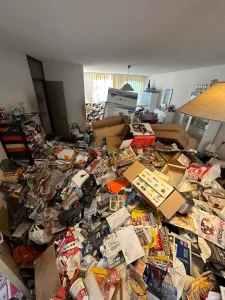
A cluttered home does not automatically mean hoarding or severe filth. However, the amount of belongings can become so overwhelming at a certain point that it’s nearly impossible to start cleaning up on your own.
Pay particular attention to situations where:
- passages or doors become blocked;
- items are stacked in an unstable manner;
- there is mold, pests, or rotten trash present;
- heavy furniture has to be carried down the stairs;
- the resident experiences a great deal of stress with every decision;
- a home must be vacated and handed over at short notice.
In a situation like this, don’t try to forcefully throw everything away in a single day. Especially when someone is very attached to their belongings, a calm and respectful approach is important. In our article on cleaning up a hoarder’s home, we explain in detail what you should and shouldn’t do in such a situation.
Is there trash, mold, pests, or severe contamination? If so, protective gear and a modified approach may be necessary. Be sure to read our information oncleaning a contaminated home.
Big clean-up? Have your items picked up
After a major cleanup, there’s often a significant amount of items left over. Think of old cabinets, couches, mattresses, appliances, boxes, and other bulky waste.
Not everyone has a trailer, a large car, or enough help to take everything to the recycling center on their own. Large pieces of furniture sometimes need to be disassembled first, and heavy items can be difficult to move down stairs or through narrow passageways.
In that case, you can use ourwaste pickup service. Send us a few clear photos of the items and let us know where they are located. I can usually quickly assess what’s needed and how much the pickup will cost.
Do you need to clear out not just some trash, but an entire home, attic, shed, or garage? In that case, we’ll work with you to determine whether a full-scale home clearance is a better fit for your situation.
Frequently asked questions about cleanup
How do I start decluttering when I’ve lost track of everything?
Choose one small, well-defined area, such as a drawer, shelf, or table. Finish that area completely before moving on to the next one. Don’t try to clear out multiple areas at once.
How long does it take to declutter a house?
That depends on the size of the home, the amount of stuff, and how easily you can make decisions. Decluttering a typical home often takes several half-days. It’s better to spread the work out over a few weeks rather than trying to do everything in one weekend.
Should I declutter or clean first?
Always declutter first. Once surfaces, floors, and cabinets are clear, you can clean much more quickly and thoroughly.
How do I decide which items to get rid of?
Ask yourself when you last used the item, whether you would buy it again, and whether it has a designated spot in your home. If the answer to all these questions is no, then it can probably go.
Where can I have large items picked up?
Large pieces of furniture, appliances, and other bulky items can sometimes be picked up by the municipality. If you’d like to have them picked up more quickly or if you have several items, you can also hire a professional waste collection service.